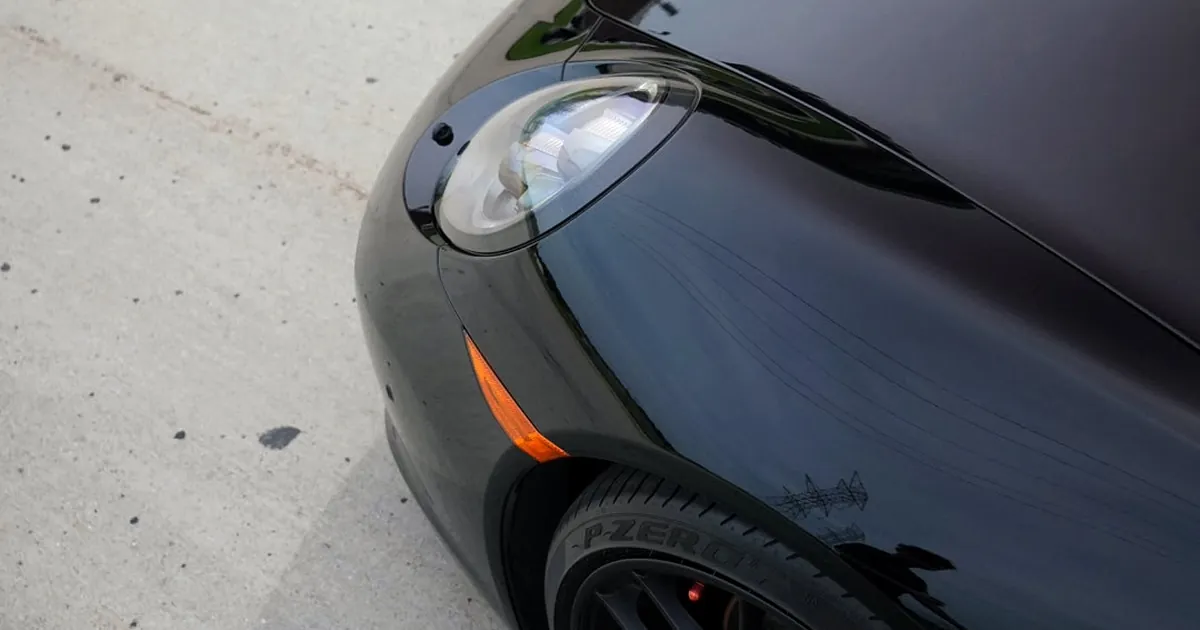

Ceramic Coating Maintenance: Keeping Your Car Brand New Through a Michigan Summer
How to maintain your ceramic coating through Michigan summers — pollen, sap, bugs, and UV. What to wash, what to avoid, and how to keep that showroom shine for years.
You just had a Feynlab ceramic coating put on your car. Your car looks like liquid glass — mirror finish, water sheeting off, bugs sliding off the front bumper. You want to keep it that way for the full 5-year warranty. Here's the thing: ceramic coating is not "set it and forget it." It's not a force field. It's a hard, hydrophobic layer on top of your clear coat that makes contaminants easier to remove — but contaminants still land on it. If you ignore them, they etch into the coating and eventually through to the paint underneath.
Michigan summers are brutal on coatings. Pollen blankets every surface from April through June. Tree sap bakes into the finish by 2pm. Bug splatter acidifies in the heat. Storm acid and hard water spots etch overnight. If you do nothing, a professional coating starts looking like a gas-station wash job by year two. Here's exactly what to do — and what NOT to do — to keep your ceramic coating performing for the full warranty period in Michigan.
The First 30 Days: Curing
Your coating is still curing for the first 2–4 weeks after application. The Feynlab formula continues cross-linking and hardening during this period.
Do
- Allow at least 2 weeks before the first wash
- Keep the car dry — avoid rain if possible (Michigan makes this hard, we know)
- Park in shade or covered areas when possible
Don't
- Don't wash the car for at least 2 weeks
- Don't apply wax, sealant, or any other product on top
- Don't take it through an automated car wash (ever — see below)
- Don't use high-pressure sprays on the coated surfaces
Weekly Maintenance: The Two-Bucket Method
After the curing period, the single most important thing you can do is wash your car regularly — every 1–2 weeks during summer when pollen and sap are at their peak.
What You Need
- Two buckets — one with soapy water, one with clean rinse water
- pH-neutral car wash soap — NOT dish soap, NOT household detergent, NOT "wash & wax"
- Microfiber wash mitt — plush, not the kind with abrasive fibers
- Microfiber drying towel — waffle weave or plush
- Grit guards for the bottom of each bucket
The Process
- Pre-rinse — hose down the entire car to remove loose pollen and dust
- Wash one panel at a time — dip mitt in soapy water, wash one section (hood, door, fender), then rinse the mitt in the clean water bucket before going back to the soap
- Rinse as you go — don't let soap dry on the surface
- Dry immediately — don't air dry. Water spots form when minerals in the water bake onto the coating in the sun
- Use the drying towel — blot and drag, don't press hard
Why Two Buckets?
The second bucket (clean rinse water) is where the dirt goes when you rinse the mitt. Without it, you're dragging the pollen and grit you just removed back across the coating — creating micro-scratches that accumulate over months. This is the number one way coatings get damaged.
Michigan-Specific Summer Threats
Pollen Season (April–June)
Michigan pollen is notorious. In Shelby Township and the surrounding suburbs, oak, maple, and pine pollen coats every horizontal surface in a yellow-green dust. Wiping pollen off dry grinds it into the coating. Pollen particles are sharp and angular — dragging a dry towel across a pollen-covered hood creates micro-scratches.
The Fix for Pollen
Always pre-rinse with water before touching the surface. Let the water float the pollen off, then wash with the two-bucket method. Never wipe pollen dry.
Tree Sap (May–August)
If you park under a tree — even once — sap can drip and bake into the coating within hours. Remove sap immediately with a dedicated sap remover or isopropyl alcohol on a microfiber towel. Don't let it sit. Once sap bakes in, it can stain the coating permanently.
Bug Splatter (June–September)
Bug guts are acidic. On bare paint, a single bug left for an afternoon can etch the clear coat. On ceramic, they sit on the surface — but only if you remove them before the acid works through. Use a dedicated bug remover spray. Let it dwell for 2–3 minutes, then wipe gently with a microfiber towel. Don't scrub — let the chemistry do the work.
Storm Acid + Hard Water Spots
Michigan summer storms drop acidic rain. When it dries on your coating, it leaves mineral deposits that can etch into the surface overnight. After a storm, either dry the car or rinse it again. Don't let rain water dry on the surface. If spots appear, use a dedicated water spot remover — but the sooner you address them, the less likely they are to become permanent.
What NEVER to Do
1. Never Take It Through an Automated Car Wash
Brush car washes are the number one cause of coating damage. The brushes pick up grit from every car before yours and drag it across your coating at high speed. Touchless car washes are better but use harsh chemicals that can degrade the coating over time. Hand wash only, or use a self-serve pressure washer bay (no brushes) on low pressure.
2. Never Use Dish Soap
Dawn dish soap strips ceramic coating. It's designed to cut grease, and your coating is essentially a hard, glass-like polymer. Dish soap breaks down the cross-linked structure over time. Use a pH-neutral car wash soap specifically formulated for ceramic-coated vehicles.
3. Never Wax Over a Ceramic Coating
Wax sits on top of the coating and fills in the hydrophobic layer with oils. It doesn't add protection — it reduces the coating's water-beading and self-cleaning properties. If you want to boost the coating, use a ceramic boost spray or silica-infused detail spray. These are compatible with the coating and enhance the hydrophobic effect.
4. Never Use High-Pressure Wash Within 6 Inches
Pressure washers are fine — they're actually great for removing loose contaminants without touching the surface. But holding the wand within 6 inches of the coating can blast the edges of the film or compromise the coating at the panel edges. Keep the wand at least 12–18 inches from the surface. Use the fan spray, not the pinpoint jet.
Annual Maintenance: The Booster
Feynlab ceramic coatings are eligible for annual booster applications. This is a light re-application of the top coat that refreshes the hydrophobic properties and extends the coating's effective life.
For 3-year and 5-year coatings, schedule a booster application at the 12-month and 24-month marks. This is included in most warranty terms and keeps the coating performing like new. For 1-year coatings, the coating is designed to be refreshed annually — schedule the reapplication at the 10–11 month mark.
How to Tell If Your Coating Is Working
The easiest test: spray water on the hood. If the water beads up into tight, round droplets that roll off the surface — your coating is performing. If the water sheets flat across the surface and stays there — the hydrophobic layer is degrading. This doesn't mean the coating is gone, but it may need a booster or a decontamination wash to restore performance. If the water stops beading entirely and the surface feels rough — the coating may be compromised. Bring it in for an inspection.
The Bottom Line
Ceramic coating is not maintenance-free — it's maintenance-easier. The coating makes contaminants easier to remove, but you still need to remove them. In Michigan, that means: wash every 1–2 weeks during summer, use the two-bucket method, pre-rinse before touching, remove sap and bugs immediately, get the annual booster, and never use automated car washes.
Do these six things and your Feynlab ceramic coating will look like the day you drove it out of our bay — for the full 5-year warranty period.
Questions about your coating? Call (586) 701-9099 or book a maintenance appointment
Frequently Asked Questions
Written by
Kade Bittner
Founder & Lead Installer
Article Info